Mindset10 October 2026
How Many Rest Days Per Week? Why Rest Isn't Lazy
How many rest days per week do you need? What the science says about recovery, sleep and stress for busy professionals, plus a simple plan to start this week.
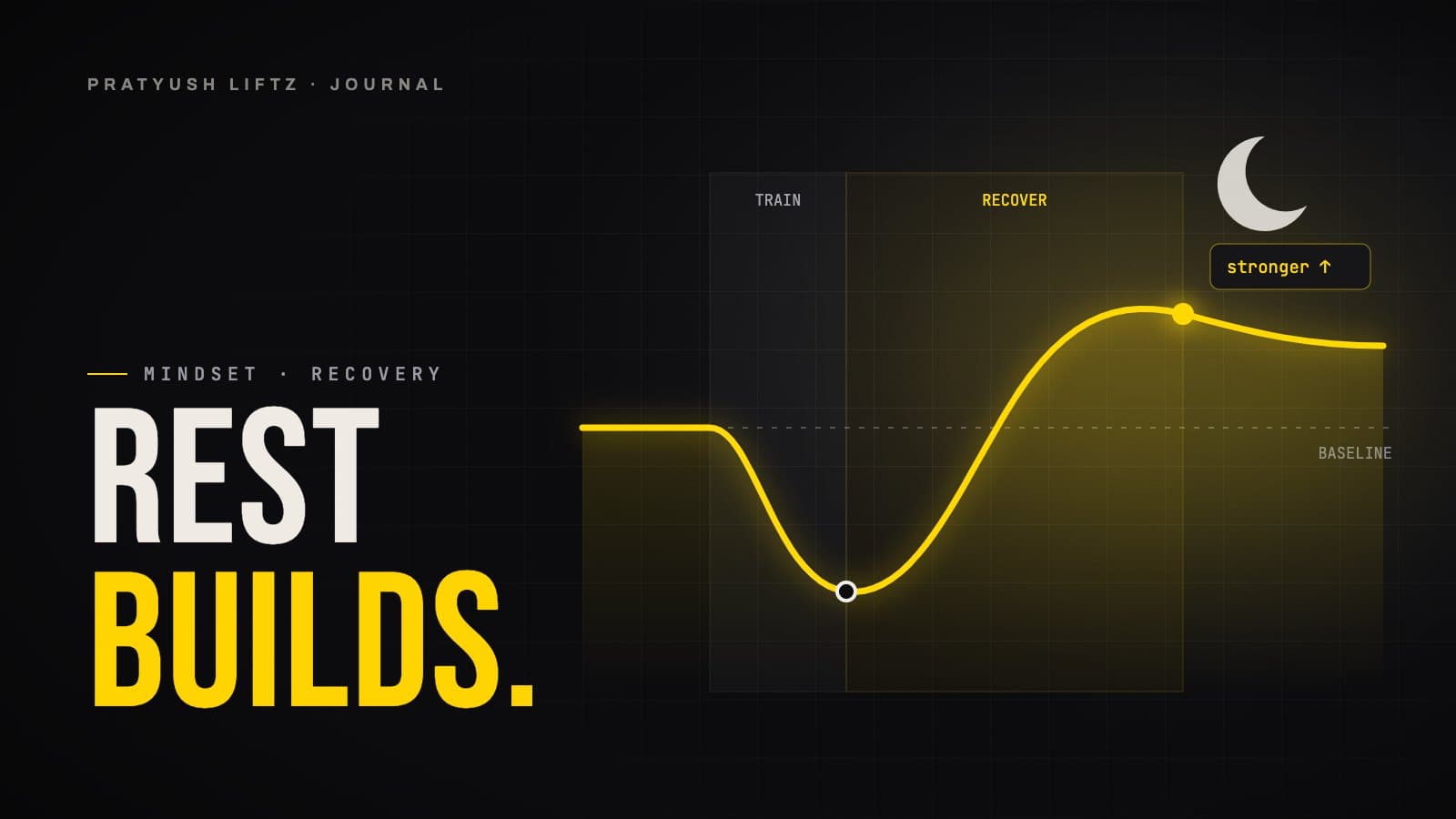
You wake up at 6, squeeze in a workout, sit through back-to-back calls, answer emails on the drive home, and fall asleep around midnight. Then you feel guilty for taking a day off from training. I see this all the time with the professionals I coach. They treat a rest day like a moral failure. Here's the truth: if your week already looks like that, a well-placed rest day is not you going soft. It's part of the programme. Planning for it is what keeps you progressing instead of grinding yourself into the ground.
Below: the importance of rest days, what the research actually says, how many rest days per week make sense for a busy schedule, what an active recovery day looks like, and the warning signs that you need more rest.
Do muscles really grow on rest days?
You've probably heard "muscles don't grow in the gym, they grow during recovery." I've said it myself. It's a useful slogan, but a simplification.
The workout is the signal. Lifting a challenging weight tells your body it needs more muscle tissue. The building happens in the hours and days after, as your body lays down new muscle protein. In a classic study, MacDougall and colleagues (1995) had young men do heavy arm training and measured muscle protein synthesis afterwards. It was more than double the untrained arm's rate at 24 hours, and by around 36 hours it had almost returned to baseline.
So neither half works without the other. No training means no signal. No recovery means the signal never fully turns into new tissue. Both count.
There's a second layer. When you're new to training, or you come back after a break, a lot of that early "building" is actually repair. Damas and colleagues (2016) took muscle biopsies from untrained young men across 10 weeks of training. In the first week, muscle damage was highest and the protein synthesis response was large, but it wasn't related to muscle growth. By weeks 3 and 10, damage had dropped, and the protein synthesis response was strongly linked to how much muscle people gained. Their conclusion: growth comes from repeated rounds of post-workout building, mostly after the muscle stops getting badly damaged by each session.
The lesson: train hard enough to send the signal, but not so often that every session leaves you in repair mode.
The workout asks for change. Recovery is where your body answers. Skip the second part and you've only done half the job.
How many rest days per week do you actually need?
This is where I have to correct a common belief, including a bit of my own original advice. More rest days are not automatically better. What matters most is total weekly training volume (hard sets per muscle) and whether you can recover from it.
On frequency, the research is reassuring for busy people. A 2016 meta-analysis by Schoenfeld, Ogborn and Krieger found that training a muscle group twice a week produced better growth than once a week. A larger 2019 meta-analysis by Schoenfeld, Grgic and Krieger, covering 25 studies, then found that when total weekly volume is equal, how often you train a muscle doesn't make a meaningful difference to growth. You can split your work across the days that suit you.
In a real week:
- 3 full-body sessions (for example Mon, Wed, Fri) gives each muscle about two to three hits a week and leaves 4 days without lifting. This is what I give most of my clients with demanding jobs.
- 4 sessions (an upper/lower split) still trains each muscle twice a week and leaves 3 days off.
- 5 to 6 sessions can work, but only if your sleep, stress and nutrition are in good shape. For most people with a 9-5, travel and a family, this is where things start to fall apart.
Rule of thumb: plan at least 2 rest days from lifting each week, and 3 to 4 is completely fine. Also try not to train the same muscle hard on back-to-back days. Given that muscle protein synthesis stays raised for roughly a day to a day and a half after a hard session, about 48 hours between hard sessions for the same muscle is a sensible default.
Why busy professionals need more recovery, not less
Your body doesn't keep separate accounts for "gym stress" and "life stress." It all draws on the same recovery budget.
Work stress slows recovery
In a study by Stults-Kolehmainen, Bartholomew and Sinha (2014), 31 students did a heavy leg workout and were then tracked for four days. The ones reporting more life stress recovered their strength more slowly and reported less energy, more fatigue and more soreness. This was a small study in university students, not executives, but the direction makes sense: under heavy stress, you may need longer between hard sessions.
Poor sleep blunts muscle building
In a randomised crossover trial, Lamon and colleagues (2021) kept 13 healthy young adults awake for one full night. The next day their muscle protein synthesis was 18% lower than after normal sleep, cortisol was 21% higher and testosterone 24% lower. That's one night of total sleep loss, which is more extreme than a few short nights. It still fits an earlier idea put forward by Dattilo and colleagues (2011): that ongoing sleep debt pushes the body towards breaking muscle down and away from building it. That paper was a hypothesis, not a trial, but later studies like Lamon's have backed parts of it.
Tiredness and injury risk
The draft version of this post said injury risk "climbs" when you skip rest. That's a reasonable concern, but I want to be honest about how strong the evidence is. The best-known data is from Milewski and colleagues (2014): in 112 adolescent athletes, those sleeping under 8 hours a night were 1.7 times more likely to have had an injury. That's an association in teenagers, not proof that one missed rest day will hurt a 38-year-old lifter. Still, it makes sense that technique gets sloppier when you're exhausted, and sloppy reps under heavy load are how most gym tweaks happen.
Overreaching vs overtraining: where the line is
Some fatigue is normal and even useful. The joint consensus statement from the European College of Sport Science and the American College of Sports Medicine (Meeusen et al., 2013) sets out three stages:
- Functional overreaching: a short dip in performance after hard training, followed by improvement once you recover. This is normal training.
- Non-functional overreaching: training and recovery have been out of balance long enough that performance stalls, and it can take weeks to bounce back.
- Overtraining syndrome: prolonged maladaptation with fatigue, falling performance and mood changes. It's hard to diagnose, and the statement notes that no single blood test or marker reliably identifies it.
To be fair, true overtraining syndrome is mostly discussed in high-volume athletes. Most busy professionals I work with are not overtrained. They're under-recovered: average training on top of short sleep, high stress and sometimes an aggressive calorie deficit. The consensus statement specifically lists low energy intake and insufficient carbohydrate or protein as factors to rule out. If you're dieting hard for fat loss, that's one more reason to protect your rest days.
What a good active recovery day looks like
A rest day doesn't mean lying on the sofa (though that's allowed). An active recovery day keeps you moving without adding real training stress. A 2018 meta-analysis by Dupuy and colleagues of 99 studies found that active recovery, along with massage and compression, can reduce muscle soreness after exercise. Massage was the most effective. Keep in mind this was about feeling less sore, not proof that you'll build more muscle.
Here's what a good active recovery day looks like for my clients:
- A 30 to 45 minute walk at a pace where you can talk comfortably. A walking meeting or a walk after dinner counts.
- 10 to 15 minutes of easy mobility or stretching for hips, upper back and shoulders, the areas that stiffen up from sitting.
- An easy cycle or swim if you enjoy it, kept genuinely light.
The test is simple. You should finish feeling better than when you started. If it leaves you tired or sore, it was a workout, not recovery.
What about deload weeks?
A deload is a planned easier week. In interviews with 18 experienced strength and physique coaches, Bell and colleagues (2022) found that most deloaded for 5 to 7 days every 4 to 6 weeks, usually by cutting sets and reps and not pushing as close to failure. But the research on deloads is still thin. In a trial by Coleman and colleagues (2024), taking a full week completely off in the middle of a 9-week programme made no difference to muscle growth, but the group that kept training gained a bit more lower-body strength.
My take: you probably don't need a fixed deload calendar. A lighter week (about half your usual sets, a few reps short of failure) during heavy travel or a crunch period at work is a smart way to keep training without digging a hole.
Warning signs you need more rest
Watch for these, especially if two or more show up together for longer than a week:
- Your lifts stall or go backwards for two or more weeks despite decent effort.
- Soreness hangs around for more than 3 days, or you're sore before you've even trained.
- You lie awake at night despite feeling exhausted.
- Your resting heart rate on waking is noticeably higher than your usual baseline.
- You dread workouts you normally enjoy, or feel irritable and flat.
- You keep catching colds, or small aches don't go away.
When this happens, take an extra rest day or run a lighter week, then look honestly at your sleep, stress and calorie intake. If symptoms persist after a couple of weeks of reduced training, see a doctor, because ongoing fatigue can have causes that have nothing to do with the gym, such as low iron.
FAQ
How many rest days per week should I take?
For most busy professionals, at least 2 days off lifting per week, and 3 to 4 is perfectly fine. Training each muscle about twice a week, with roughly 48 hours between hard sessions for the same muscle, covers most goals.
Will I lose muscle if I take a rest day?
No. Muscle protein synthesis stays raised for roughly a day or more after a hard session, so a rest day is when part of that building happens. Even a full week off had no effect on muscle growth in a 2024 trial. That group did gain a little less strength.
Is it okay to walk on a rest day?
Yes. A comfortable 30 to 45 minute walk is one of the best active recovery options. It supports fat loss and may ease soreness without adding real training stress.
Is it bad to work out every day?
Not necessarily, if the sessions are short and you rotate muscle groups. But for people with heavy work stress and limited sleep, daily hard training often adds up to more fatigue than they can recover from. Fewer, better sessions usually win.
Start this week
- Put your rest days in your calendar on Sunday, just like your workouts. Aim for at least 2.
- Avoid training the same muscle hard on back-to-back days.
- On at least one rest day, take a 30 to 45 minute easy walk plus 10 minutes of mobility.
- Protect your sleep window: aim for 7 to 9 hours, and treat a short night as a reason to train lighter.
- If work is brutal this week, cut your sets by about half instead of skipping training entirely.
- Check the warning-sign list on Friday. If two or more apply, add an extra rest day next week.
Rest isn't a break from the plan. It's how the plan turns into results.
Sources12
- MacDougall JD, Gibala MJ, Tarnopolsky MA, MacDonald JR, Interisano SA, Yarasheski KE (1995). The time course for elevated muscle protein synthesis following heavy resistance exercise. Canadian Journal of Applied Physiology.
- Damas F, Phillips SM, Libardi CA, et al. (2016). Resistance training-induced changes in integrated myofibrillar protein synthesis are related to hypertrophy only after attenuation of muscle damage. The Journal of Physiology.
- Schoenfeld BJ, Ogborn D, Krieger JW (2016). Effects of Resistance Training Frequency on Measures of Muscle Hypertrophy: A Systematic Review and Meta-Analysis. Sports Medicine.
- Schoenfeld BJ, Grgic J, Krieger J (2019). How many times per week should a muscle be trained to maximize muscle hypertrophy? A systematic review and meta-analysis of studies examining the effects of resistance training frequency. Journal of Sports Sciences.
- Meeusen R, Duclos M, Foster C, et al. (2013). Prevention, diagnosis, and treatment of the overtraining syndrome: joint consensus statement of the European College of Sport Science and the American College of Sports Medicine. Medicine & Science in Sports & Exercise.
- Stults-Kolehmainen MA, Bartholomew JB, Sinha R (2014). Chronic psychological stress impairs recovery of muscular function and somatic sensations over a 96-hour period. Journal of Strength and Conditioning Research.
- Lamon S, Morabito A, Arentson-Lantz E, et al. (2021). The effect of acute sleep deprivation on skeletal muscle protein synthesis and the hormonal environment. Physiological Reports.
- Dattilo M, Antunes HK, Medeiros A, et al. (2011). Sleep and muscle recovery: endocrinological and molecular basis for a new and promising hypothesis. Medical Hypotheses.
- Milewski MD, Skaggs DL, Bishop GA, et al. (2014). Chronic lack of sleep is associated with increased sports injuries in adolescent athletes. Journal of Pediatric Orthopaedics.
- Dupuy O, Douzi W, Theurot D, Bosquet L, Dugué B (2018). An Evidence-Based Approach for Choosing Post-exercise Recovery Techniques to Reduce Markers of Muscle Damage, Soreness, Fatigue, and Inflammation: A Systematic Review With Meta-Analysis. Frontiers in Physiology.
- Bell L, Nolan D, Immonen V, et al. (2022). "You can't shoot another bullet until you've reloaded the gun": Coaches' perceptions, practices and experiences of deloading in strength and physique sports. Frontiers in Sports and Active Living.
- Coleman M, Burke R, Augustin F, et al. (2024). Gaining more from doing less? The effects of a one-week deload period during supervised resistance training on muscular adaptations. PeerJ.